

What Makes Up A Persons Racial Makeup
Democrats Racially Various; Republicans Mostly White
Democrats and independents grow more diverse since 2008
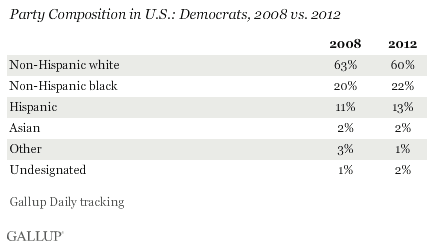
PRINCETON, NJ -- Non-Hispanic whites deemed for 89% of Republican self-identifiers nationwide in 2012, while accounting for seventy% of independents and 60% of Democrats. Over one-fifth of Democrats (22%) were black, while 16% of independents were Hispanic.
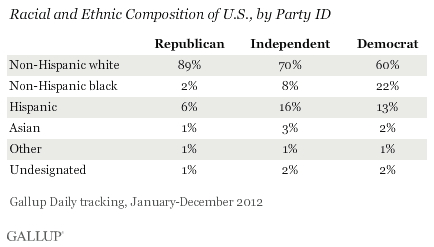
These results are based on more 338,000 interviews conducted as part of Gallup Daily tracking in 2012, and clearly underscore the singled-out racial profiles of partisan groups in today'southward political landscape.
- Republicans are overwhelmingly not-Hispanic white, at a level that is significantly higher than the self-identified white percentage of the national adult population. Just 2% of Republicans are black, and vi% are Hispanic.
- Seventy percent of Americans who identify as independents are white, but independents have the highest representation of Hispanics (16%) of the three groups. 8 per centum of independents are blacks.
- Democrats remain a majority white party, only four in 10 Democrats are something other than not-Hispanic white. More than one in v Democrats are blackness, roughly twice the black representation in the adult population.
Racial and Ethnic Groups Gravitate Toward Different Parties
Looked at differently, these political party composition patterns reverberate major differences in the way Americans in diverse racial and indigenous groups identify their political affiliation.
- Nigh 2-thirds of blacks identify as Democrats, with almost of the residual identifying every bit independents. Merely v% of blacks nationwide identify as Republicans.
- Half of Hispanics place equally independents, although the bulk of the residue place equally Democrats. This is despite their high level of approval and strong bulk voting support for Democratic President Barack Obama. Relatively few Hispanics (13%) place every bit Republicans.
- Whites are the most politically diverse of the three major racial and ethnic segments, with between 26% and 38% identifying with one of the 3 partisan groups. Whites tilt slightly toward being independents or Republicans rather than Democrats. The large white concentration of Republican identifiers, in short, is caused past a dearth of nonwhites self-identifying with the GOP, rather than a monolithic Republican orientation among whites.
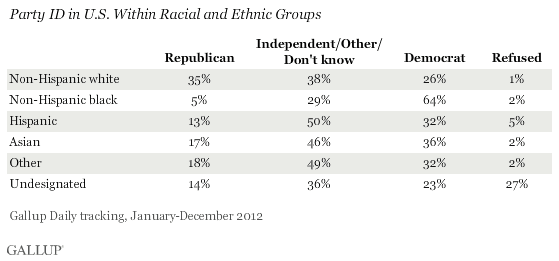
Although Asians and other races make up a small-scale proportion of the U.Due south. population, the data show that the political pattern they follow is quite similar to that of Hispanics: they are most likely to identify as independents, 2d-most likely to identify as Democrats, and least likely to identify as Republicans.
Racial Breakdown of Independents and Democrats Has Shifted Most Since 2008
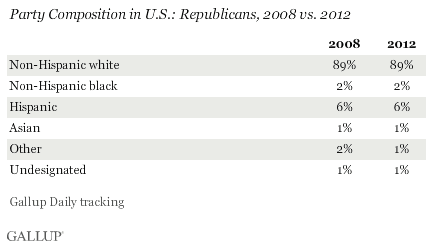
The racial and ethnic limerick of the Republican Party today is similar to what it was in 2008, the yr when Gallup began its daily tracking. There accept been substantially no changes in the per centum of GOP identifiers who are white, black, and Hispanic.
Independents have get more Hispanic since 2008 (and slightly more black), while Democrats have go more black and more Hispanic. Phrased differently, the independent and Democratic segments of the U.Due south. population are now less white than they were in 2008, reflecting the uptick in the U.S. nonwhite population over these five years.
Implications
Ane of the more than important realities in American politics today is the substantial divergence in the racial and ethnic limerick of the major political parties. Virtually nine in x Republicans are white, in stark contrast to the racial and ethnic composition of the overall adult population. On the other hand, the Autonomous Party is disproportionately nonwhite.
The future of the 2 major political parties depends on two factors. The commencement is whether these patterns of party identification alter in the years ahead. The ability of the Republican Party to make inroads amongst nonwhites has been much discussed in recent months, peculiarly the GOP's efforts to improve on the 13% allegiance that Gallup data show it obtains from Hispanics. Another path to growth for the Republican Political party would be an increase in its penetration into the white sector of the population, only 35% of which now identifies every bit Republican. On the other hand, the Democratic Party will grow if it likewise can extend its identification amid whites, and maintain or strengthen its position among nonwhites.
A second cistron that will impact the futurity of the political parties in the U.Due south. is straightforward demographics. Projections evidence that the nonwhite proportion of the American adult population will abound in the years ahead. This ways that if electric current partisan fidelity patterns prevail, the size of the Democratic base of operations will be in a better position to abound than will the Republican base.
Survey Methods
Results for this Gallup poll are based on phone interviews conducted Jan. 2-Dec. 30, 2008, and Jan. 2-Dec. thirty, 2012, on the Gallup Daily tracking survey, with a random sample of 353,334 adults, aged xviii and older, living in all 50 U.S. states and the District of Columbia in 2008, and a random sample of 338,703 adults in 2012.
For results based on the full sample of national adults in both 2008 and 2012, one can say with 95% confidence that the margin of sampling fault is ±1 percent bespeak.
Interviews are conducted with respondents on landline telephones and cellular phones, with interviews conducted in Spanish for respondents who are primarily Spanish-speaking. Each sample of national adults includes a minimum quota of 50% jail cell phone respondents and l% landline respondents, with boosted minimum quotas by region. Landline telephone numbers are chosen at random among listed telephone numbers. Prison cell phones numbers are selected using random digit dial methods. Landline respondents are chosen at random within each household on the basis of which member had the most recent altogether.
Samples are weighted to right for unequal selection probability, nonresponse, and double coverage of landline and cell users in the two sampling frames. They are besides weighted to match the national demographics of gender, age, race, Hispanic ethnicity, education, region, population density, and telephone status (cellphone only/landline only/both, cellphone by and large, and having an unlisted landline number). Demographic weighting targets are based on the March 2012 Current Population Survey figures for the aged eighteen and older U.S. population. Telephone status targets are based on the July-December 2011 National Wellness Interview Survey. Population density targets are based on the 2010 census. All reported margins of sampling fault include the computed pattern effects for weighting.
In improver to sampling mistake, question wording and applied difficulties in conducting surveys tin introduce error or bias into the findings of public opinion polls.
For more details on Gallup's polling methodology, visit www.gallup.com.
Gallup https://news.gallup.com/poll/160373/democrats-racially-diverse-republicans-mostly-white.aspx
Gallup World Headquarters, 901 F Street, Washington, D.C., 20001, U.S.A
+ane 202.715.3030
Source: https://news.gallup.com/poll/160373/democrats-racially-diverse-republicans-mostly-white.aspx
Posted by: moralesguithay.blogspot.com
0 Response to "What Makes Up A Persons Racial Makeup"
Post a Comment