

What Does Makeup Represent In A Play


Make-up artist Dubi Preger finishing a make-up pattern.

Marcus Stewart wears face brand-up in Oresteia past Aeschylus, adapted by Stairwell Theater, 2019
Theatrical makeup is makeup that is used to assist in creating the advent of the characters that actors portray during a theater product.
Background [edit]
In Greek and Roman theatre, makeup was unnecessary. Actors wore diverse masks, allowing them to portray another gender, age, or entirely different likeness.[1] Thespis, considered to be the first thespian, used white lead and vino to paint his face.[2] In medieval Europe, actors altered their appearances by painting their faces a different color. Performers who portrayed God painted their faces white or gold; actors playing angels painted their faces crimson.[one] During the Renaissance, actors were creative and resourceful when making-over their faces. They used lamb's wool for false beards and flour as face up paint.[i]
Advancements in stage lighting technology required phase makeup to evolve beyond one over-all face up colour to a multidimensional arts and crafts. Originally, theatres used candles and oil lamps; these two sources of light were dim and allowed for crude, unrealistic makeup applications.[1] Once gas lighting, limelight and electric light were introduced to theatres, a need emerged for new makeup materials and more skillful awarding techniques. In 1873, Ludwig Leichner, a Wagnerian opera vocaliser, began commercially producing a non-toxic greasepaint stick, easing the application of makeup.[1]
Highlight and shadow [edit]
Through the use of makeup, specifically highlighting and shading, the apparent shape of an role player'due south face can be changed.[3] By highlighting the face'due south protruding bones, the features become pronounced; shadowing cavities can add depth.[4] Sagging jowls, forehead wrinkles, eye pouches, and prominent veins can exist created past manipulating highlights and shadows.[3] A highlight is a base makeup that is at to the lowest degree two shades lighter than the base. It is applied on the bridge of the nose, cheekbones, and areas under the eyes and below the brows.[4] Using a color two shades deeper than the base provides depth and definition. This depth is commonly used on the center sockets, to thin the sides of the nose, to shallow the cheeks, and to minimize heaviness under the chin.[four]
Makeup and lighting [edit]
Lighting controls makeup to a high degree. Makeup tin lose its effectiveness due to incorrect phase lighting. Conversely, proficient lighting tin greatly assistance the art of makeup. Close communication between the lighting managing director and the makeup artist is crucial for the best possible outcome.[five]
Understanding light's effect on makeup and various shades and pigments is important when designing a performer's makeup. The post-obit are among the basic rules of lite: nothing has colour until calorie-free is reflected from it; an object appears blackness when all of the light is absorbed; an object appears white when all of the light is reflected. If sure rays are captivated and others are reflected, the reflected rays determine the colour.[3]
Light's effect on makeup [edit]
- Pink tends to grey the cool colors and intensify the warm ones. Yellow becomes more orange.
- Flesh pink flatters most makeup.
- Fire red ruins makeup. All only the darker flesh tones virtually disappear. Light and medium rouge fade into the foundation, whereas the dark cherry-red rouges turn a reddish brown. Xanthous becomes orange, and the cool shading colors become shades of gray and black.
- Bastard bister is flattering because it picks up the warm pinks and flesh tones in the makeup.
- Bister and orange intensifies and yellow most flesh colors. They plow rouges more orangish. Cool colors are grayed.
- Green grays all flesh tones and rouges in proportion to its intensity. Light-green will exist intensified. Yellowish and blueish will get greener.
- Light blueish-greenish lowers the intensity of the base of operations colors. One should more often than not utilize very little rouge nether this type of light.
- Greenish-blue washes out stake flesh tones, and will grayness medium and deep flesh tones, likewise every bit all reds.
- Dejection gray near flesh tones and cause them to appear more cerise or purple.
- Violet causes orange, flame, and ruddy to become redder. Rouge appears more intense.
- Regal affects makeup like violet lighting, except reds and oranges will be even more intense, and most blues will look violet.[3]
Directly makeup [edit]
Straight makeup is a style of makeup that provides a natural, clean and salubrious glow.[4]
Skin [edit]
If a performer's skin is perfectly toned, makeup spreads smoothly and adheres easily. Dry skin or oily peel is dealt with prior to makeup application; otherwise, the makeup appears blotchy or smeared due to variations in absorption. Performers with dry out pare use a moisturizer daily and later their faces take been cleansed following a performance. Performers with oily complexions use a facial toner wipe or astringent to remove the oil and permit a polish application.[4]
Skin has 4 basic tones: brown, fair, pink and olive. Individuals with fair, pink, and olive skin tones use olive, beige, or suntan bases. Makeup artist and performers select shades compatible with the natural skin tone, but the base is ane to several shades deeper. Performers with predominately pink or cherry-red complexions use base of operations colors with cool undertones. The grapheme, size of the theatre, and low-cal intensity will determine the tone depth of the foundation.[4]
A thin layer of base makeup is applied to the cervix, ears, and face using a white prophylactic sponge or fingers. A heavy application of base appears aged and creepy.[4]
Rouge [edit]
Fair complexions are enhanced by soft shades of peach and pinkish, while brown complexions are best accented with coral shades. The moist powder is practical before pulverization; dry rouge is used to emphasis the already powdered makeup.[4]
Eyes [edit]
Eyes and eyebrows are the greatest communicative tool in an player's arsenal. They are the most expressive feature on the face.[four]
Middle shadow [edit]
Grease or stick shadow is applied to the eyelids and blended out toward the eyebrow os before powder is applied; dry eye shadow is used alone or to intensify and bear upon up the color underneath. Dark eye shadow or grease deepens the eye sockets, creating a skull-similar effect. Shades of brown and gray are best for individuals with fair complexions. Individuals with brown complexions use lighter shadows such as toast, mushroom or soft yellows.[4]
Centre liner [edit]
Liquid eyeliner, block eyeliner, or the eyebrow pencil is used to accent and frame the eyes. There are 2 means to line the upper lid of the heart: the owl middle or the almond centre. The owl middle is used to widen the eye and involves using a heavier line in the eye of the lid. The almond-shaped eye is created past extending the line out beyond the outer corner of the eye. The lower line is created by using the same tool used on the upper lid. The line begins a quarter-inch from the inner corner of the eye. This extra infinite is needed to open the eye.[4]
Eyelashes [edit]
Mascara is used to add extra attention to the eyes. Black lash mascara is the about popular and commonly used by women with fair and brown complexions. Very fair individuals and men use dark-brown mascara. The bottom lashes are coated with mascara and to avoid using imitation lashes, a procedure of layering powder and mascara is used to provide greater thickness.[four]
Pulverization [edit]
A generous amount of pulverisation is needed to reduce unwanted shine. If a performer'south makeup is under-powdered, his peel oils will interruption through apace, producing shine and possibly running. After powder is applied to the entire face, starting under and effectually the eyes, it is gently pressed for thirty seconds. The excess is brushed off with a large soft brush or piece of cotton. A wet natural sponge or cotton is wiped lightly beyond the face to set the makeup, to remove whatsoever visible powder, and to eliminate the masky feeling.[four]
Translucent powders are used for fair complexions because they practice not modify the original color of the base, the under-rouge, or the moist eye shadow. Brown complexions are set with tinted that is compatible with the base color. It is used sparingly over the under-rouge and moist eye shadow. Later the powder is applied, dry heart shadow and dry rouge are added.[iv]
Lips [edit]
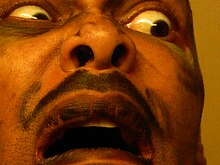
Applied makeup to the lips and cheeks assisting in the conveyance of emotion.
Though the eyes are the most expressive feature of the face, the eyes and ears of the audience follow mouth movements to understand a play's progression. If a performer's lips are underdone or overplayed, they volition detract from the performer and the performance. A general dominion is: the larger the oral fissure, the deeper the lipstick tone. However, the thespian should not appear "all mouth".[iv]
Fair complexions use shades of lipstick like pink and coral. Brown complexions are enhanced by coral and orange shades. Ruby lipsticks are reserved for large theatres and character portrayals. An auburn or brown pencil are used to provide definition to the lips. Lipsticks on men tin look doll-like. Men apply natural-colored lipsticks, lightly practical.[4]
Preparation/Education [edit]
Because stage actors are seen from farther abroad than actors on screen, information technology is crucial that their makeup is more than dramatic and professionally done. Many higher-learning institutions have drama departments where all aspects of theater are taught, including the art of theatrical makeup. Some independent agencies also provide classes in theatrical makeup, and online courses are also available. Through training, makeup artists learn important techniques such every bit hand-heart coordination, power to depict straight lines and consistent shapes, creativity, good preparation and personal hygiene habits, etc. Many makeup artists who specialize in theatrical makeup build portfolios to show their clients and employers. Many of them work as freelance makeup artists or work for cosmetics brands in section stores.
Come across likewise [edit]
- Theatrical blood
- Blackface
References [edit]
- ^ a b c d e "makeup (performing arts) -- Britannica Online Encyclopedia". Encyclopædia Britannica. 2009. Retrieved 2009-02-07 .
- ^ Tara Maginnis (2008). "History of Theatre Makeup before 1920". Retrieved 2009-11-24 .
- ^ a b c d Corson, Richard (1986). Phase Makeup. New Jersey: Prentice Hall. pp. 6, 8, 16–18.
- ^ a b c d eastward f yard h i j k fifty m due north o p Westmore, Michael Thou. (1973). The Art of Theatrical Makeup for Phase and Screen. New York: McGraw-Hill, Inc. pp. 2, 21–29. ISBN0-07-069485-0.
- ^ Kehoe, Vincent (1969). The Technique of Film and Television set Brand-Up for Color and Black and White. New York: Hastings Firm Publishers. p. 21. ISBN0-240-44942-eight.
Source: https://en.wikipedia.org/wiki/Theatrical_makeup
Posted by: moralesguithay.blogspot.com
0 Response to "What Does Makeup Represent In A Play"
Post a Comment